
Quick Facts
• Choose a conference by the problem you need to solve, not by the brand.
• The strongest predictors of value are who presents, how sessions are framed, and whether you can benchmark with peers.
• Hybrid access and recordings multiply the value of a ticket for the whole team.
Why the choice matters more in 2027
Attending a conference is a real investment. It costs three days away from work, plus travel and accommodation, plus the ticket itself.
In 2027 that investment will be examined more closely than before. AI budgets are under growing scrutiny. Forrester predicted that enterprises would defer a quarter of their planned 2026 AI spending into 2027, and finance teams are taking a much more active role in approving technology investments. Learning and event budgets face the same test. Before approving a conference, managers want a clear answer to a simple question: what will we bring back?
The good news is that the difference between a valuable conference and a forgettable one is usually visible in advance. Ten questions can help you tell them apart.
Ten questions to ask before you book
Look at the session titles. A session called “How do you stop wrong AI answers from reaching stakeholders?” promises practical learning. One called “Introducing Product X 4.0” promises a sales presentation. Problem-led programmes are a reliable sign that the organiser has thought about what attendees need.
In 2027, AI capability depends on engineers, architects, governance specialists, analysts and business leaders working together. An event that covers all of these disciplines lets you send a team rather than a single person, and the team comes back with a shared understanding of the problem.
Keynotes inspire, but most practical learning happens in technical sessions, hands-on workshops and small-group formats. Check whether the event offers these, and whether they are included in the ticket.
For senior leaders especially, the most valuable hour of a conference is often a closed-door conversation with peers facing the same challenges. Look for round tables, curated networking and meeting tools.
Generic AI advice often falls apart when it meets regulation, legacy systems or physical operations. Sector-specific content saves you the work of translating general lessons to your own industry.
At any multi-track event you will miss most sessions. Live streams and on-demand recordings turn a ticket into a resource the whole team can use for weeks afterwards.
A very small event limits who you can meet, and a very large one can turn networking into noise. Somewhere between 2,000 and 5,000 attendees is often the sweet spot for meeting the right people.
Add up the ticket, travel, accommodation and time away from work, then subtract what is included: food, evening events, recordings and any discounts for booking early or as a group.
The best conferences change what you do the following Monday. Ask colleagues or past attendees what they actually changed after attending.
How the Data Innovation Summit measures up
Applied to the Data Innovation Summit, these questions point to its strengths.
- Speakers: Priority is given to enterprise and public sector organisations.
- Session framing: Every Foundation Days session is framed as a practitioner question.
- Whole-team coverage: Fifteen stages run from engineering and architecture through governance and analytics to five industry stages.
- Depth: Seven workshop rooms offer 100-minute sessions limited to 24 people each.
- Peer benchmarking: Executive Round Tables bring together up to 32 CDOs or CAIOs at a time.
- Recordings: Every session is available on demand for five weeks.
- Audience and cost: Around 3,500 delegates from over 50 countries attend. Early-bird pricing, group discounts of 15-20%, and included food and evening events keep the total cost predictable.
Frequently asked questions
Yes, if you choose by the problem you need to solve and prepare properly. Arrive with clear questions, book meetings in advance and write a short briefing afterwards so the value reaches your whole organisation.
Both have value. Vendor conferences offer depth on a single platform. Independent summits let you compare approaches across vendors and learn how peers solved similar problems.
Most teams get the best return from one flagship event attended as a team, complemented by a few specialist events for individuals with specific needs.
About the Data Innovation Summit
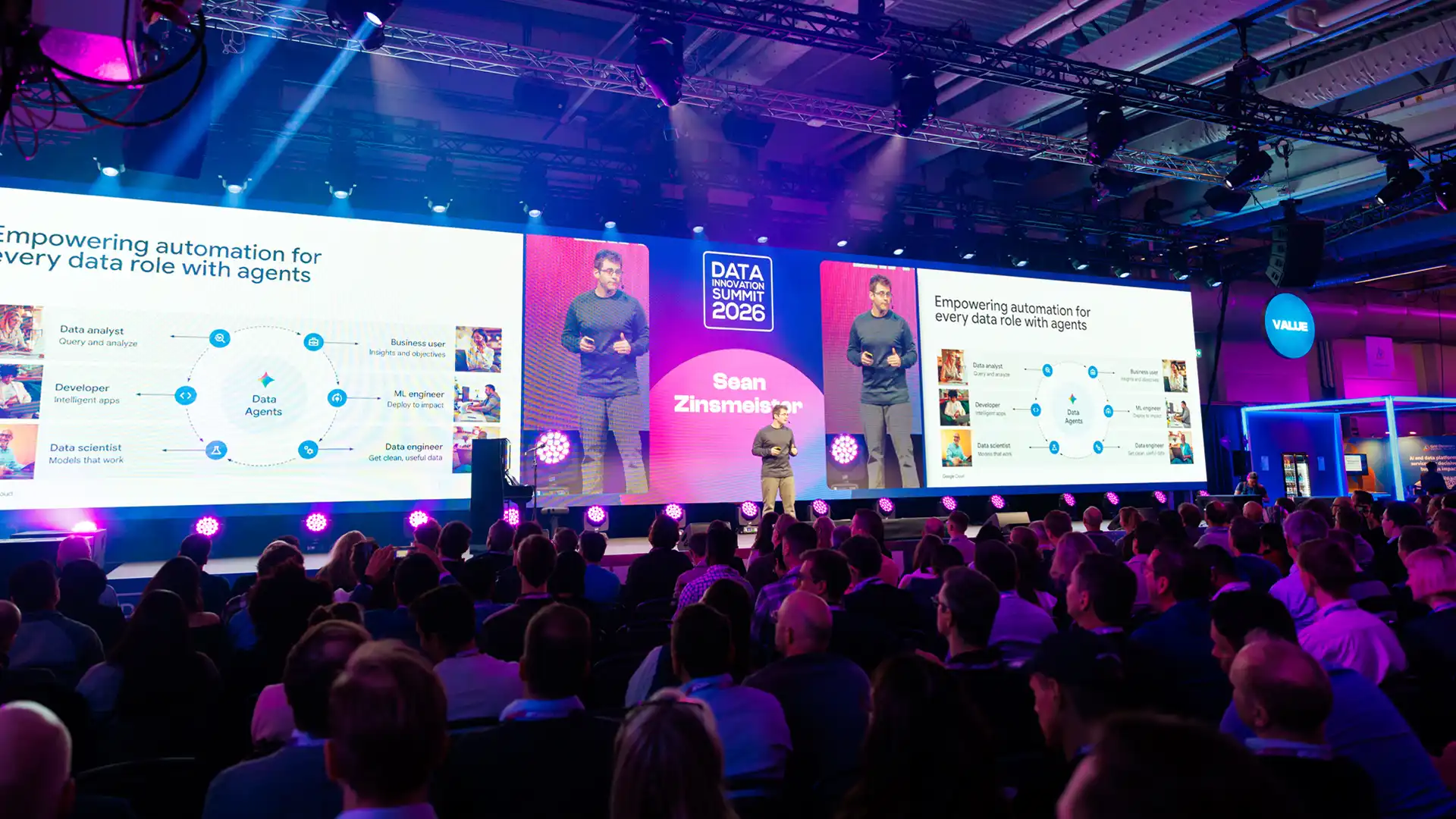
The Data Innovation Summit is the largest and most influential annual applied data, analytics and AI event in the Nordics, organised by Hyperight in Stockholm since 2016. The 12th edition, DIS2027X2, takes place on 18–20 May 2027 at Kistamässan in Stockholm under the theme “From Data & AI to Enterprise Capability”.
The summit brings together more than 3,500 practitioners, business leaders, technology providers, start-ups and academics from over 50 countries. The programme runs across fifteen stages: two Foundation Days dedicated to data, analytics and AI capabilities, and an Industry Day covering five sectors.
The summit is a hybrid event, with every session streamed live and available on demand.
Regional editions are held in Dubai, Singapore and Sydney.
Learn more at datainnovationsummit.com.